


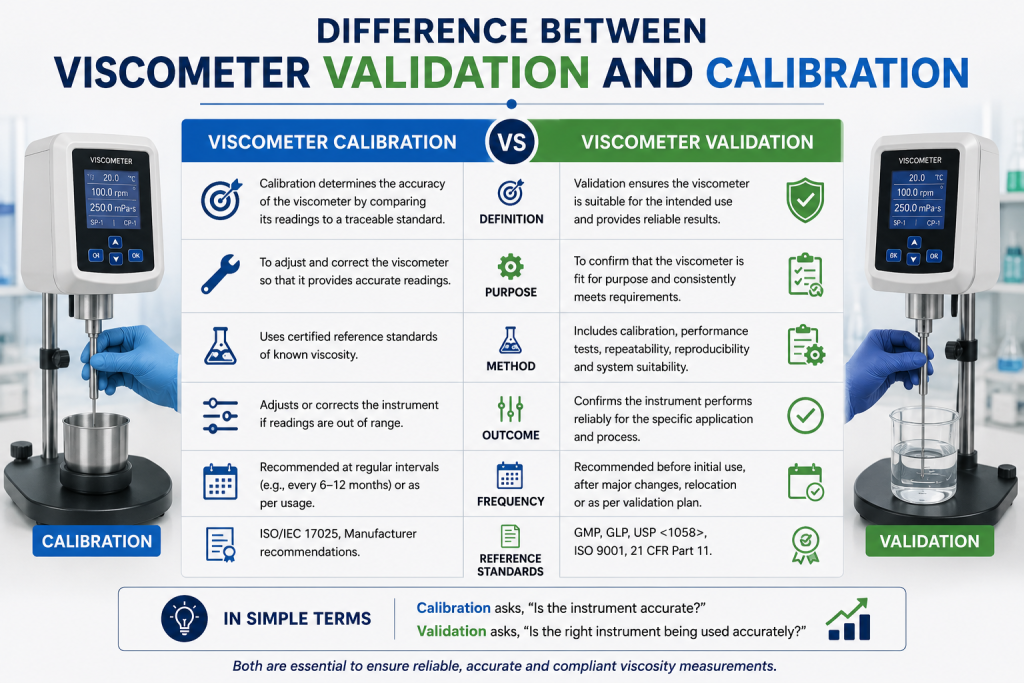
If you work in a regulated industry, you have probably heard the terms viscometer calibration and viscometer validation used interchangeably. They are not the same. Confusing one with the other can lead to compliance gaps, audit observations, and even product recalls.
This blog explains the difference between viscometer calibration and validation, when each is required, and how they work together in a GMP-compliant quality system.
Quick Definitions
Calibration is the process of comparing the measurement of an instrument against a certified reference standard and adjusting it to match — or quantifying the deviation — to ensure the instrument provides accurate readings.
Validation is the documented process of demonstrating that an instrument, system, or method consistently performs as intended for its specific application in your environment.
In simple terms:
- Calibration answers: “Is the instrument accurate?”
- Validation answers: “Is the instrument fit for our intended use?”
Detailed Comparison: Calibration vs Validation
Parameter | Calibration | Validation |
Purpose | Verify and adjust measurement accuracy | Confirm fitness for intended use |
Frequency | Periodic (3, 6, or 12 months) | At installation, after major changes, and during requalification |
Performed by | NABL-accredited calibration lab | In-house validation team or qualified service provider |
Scope | Instrument readings vs reference standards | Entire instrument system, including software, environment, method |
Output | Calibration certificate | Validation protocol (IQ, OQ, PQ) and report |
Documentation | Calibration certificate with traceability and uncertainty | URS, FAT, IQ, OQ, PQ, and validation summary report |
Standard | ISO/IEC 17025 | GMP, GAMP 5, 21 CFR Part 11, USP <1058> |
Trigger | Time-based (per SOP) | Event-based (new install, major upgrade, relocation) |
What Calibration Covers
A typical viscometer calibration covers:
- Torque accuracy
- RPM accuracy
- Viscosity reading vs certified standard oils
- Temperature sensor accuracy
- Display and output accuracy
- Repeatability check
The result is a calibration certificate confirming the instrument is within manufacturer’s stated accuracy
Validation, especially in pharmaceutical environments, follows the IQ-OQ-PQ approach:
1. Installation Qualification (IQ)
Confirms the viscometer has been delivered, installed, and configured as per manufacturer specifications and user requirements.
Includes:
- Verification of model, serial number, accessories
- Power supply and environmental conditions check
- Installation as per OEM manual
- All documentation (manuals, certificates) received
2. Operational Qualification (OQ)
Confirms the viscometer operates as specified across its full operating range.
Includes:
- All RPM settings function correctly
- Display, keypad, and software work as expected
- Alarms, security, and audit trails function
- Performance verification using standard oils
- 21 CFR Part 11 compliance (where applicable)
3. Performance Qualification (PQ)
Confirms the viscometer performs reliably in the actual user environment with actual products.
Includes:
- Testing with real product samples
- Reproducibility studies
- Long-term performance monitoring
- Operator performance verification
USP <1058> Classification
USP General Chapter <1058> categorises analytical instruments into three groups:
- Group A – Standard equipment with no measurement capability (e.g. magnetic stirrer)
- Group B – Standard instruments with measurement (e.g. balances, pH meters,
viscometers) - Group C – Complex instruments (e.g. HPLC, mass spectrometers)
For Group B instruments, both calibration and operational checks are required, with formal IQ/OQ documentation expected during installation and major changes.
When Do You Need Calibration vs Validation?
You Need Calibration:
- At periodic intervals defined by your SOP (e.g. every 6 months)
- After repair or component replacement
- After relocation of the instrument
- If readings drift or fail daily verification
- Before any major audit
You Need Validation:
- At first installation (IQ + OQ + PQ)
- After major hardware or software upgrades
- After significant changes to the operating environment
- Periodically as per your validation master plan (typically every 3–5 years)
- When introducing the viscometer for a new product or method
Common Misconceptions
Misconception 1: “If we have a calibration certificate, we don’t need validation.” Reality: Calibration is one part of validation. Validation also covers software, environment, and method — which calibration does not.
Misconception 2: “Validation is a one-time activity.” Reality: Validation must be reviewed and re-performed periodically, especially after major changes
Misconception 3: “Only software-driven instruments need validation.” Reality: Even simple electronic viscometers require IQ/OQ documentation in regulated environments.
Final Thoughts
Viscometer calibration vs validation is not an either/or question. Both are essential,
complementary activities in a robust quality system. Calibration ensures your instrument is accurate; validation ensures it is fit for your specific intended use.
If you operate in pharma, biotech, food, or cosmetic industries, your SOPs must clearly define when and how each activity is performed.
Need help with both viscometer calibration and IQ/OQ/PQ validation? Our NABL-accredited team offers complete calibration and validation services for Brookfield, Anton Paar, and other major viscometer brands. Contact us today for a tailored solution.