


In the pharmaceutical industry, even the smallest measurement error can compromise product quality, patient safety, and regulatory compliance. Viscosity is one of the most critical parameters monitored during the manufacturing of syrups, ointments, creams, gels, suspensions, and injectables. This is exactly why viscometer calibration is not just a best practice — it is a nonnegotiable requirement.
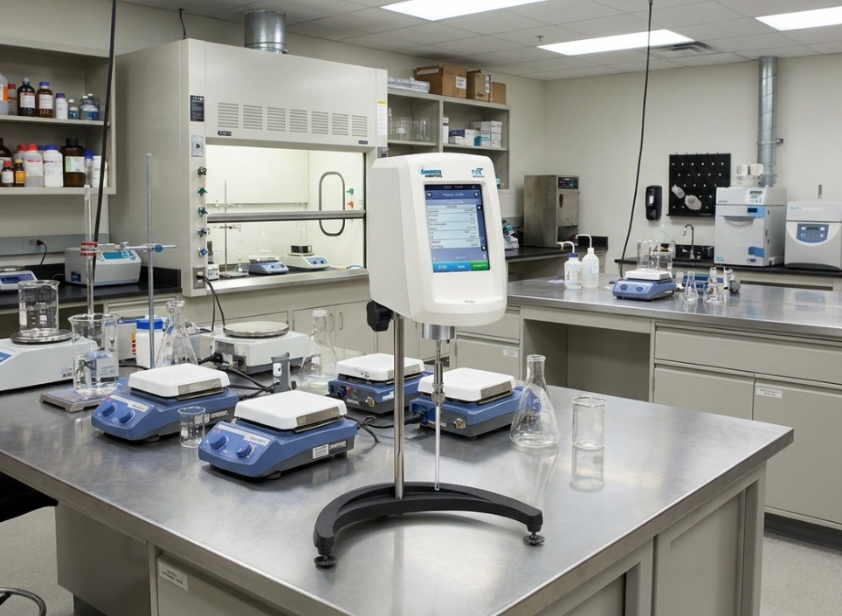
A viscometer measures the resistance of a fluid to flow. Over time, due to spindle wear, temperature drift, mechanical stress, or environmental factors, the readings of a viscometer can deviate from true values. Viscometer calibration is the process of comparing the instrument’s readings against certified reference standards (such as standard viscosity oils) and adjusting it to ensure accurate, repeatable, and traceable measurements.
For pharma manufacturers, brookfield viscometer calibration is the most commonly performed calibration because Brookfield rotational viscometers are the industry standard for measuring the viscosity of pharmaceutical formulations.
Why Calibration Matters in Pharmaceuticals
1. GMP Compliance
Good Manufacturing Practice (GMP) guidelines, including those issued by the WHO, US FDA, MHRA, and CDSCO, mandate that all measuring equipment used in production and quality control must be calibrated at defined intervals. A non-calibrated viscometer is an immediate red flag during any GMP inspection.
Calibration records, calibration certificates, and traceability to national or international
standards (such as NIST or NPL) are essential parts of your GMP documentation.
2. Audit Readiness
Pharmaceutical companies are subject to frequent audits — internal audits, customer audits, and
regulatory inspections from authorities such as the US FDA, WHO-GMP, EU-GMP, and Indian
FDA. Auditors specifically check:
- The calibration certificate of every viscometer in use
- The calibration due date
- The accreditation status of the calibration laboratory (NABL / ISO 17025)
- The traceability chain of reference materials used
A missing or expired calibration certificate can result in audit observations, 483 warning letters, or even product recalls. Regular viscosity meter calibration services keep your facility auditready throughout the year.
3. Accuracy and Product Quality
Viscosity directly affects:
- Suspensions and syrups – ensures proper dose uniformity and pourability
- Creams and ointments – determines spreadability, stability, and patient comfort
- Injectables – affects syringeability and the safety of administration
- Coating solutions for tablets – influences uniform film thickness
An inaccurate viscometer can lead to entire batches being rejected, costing lakhs of rupees in lost product, raw materials, and downtime. Calibration protects this investment.
4. Batch-to-Batch Consistency
Pharmaceutical formulations must be reproducible. A calibrated viscometer ensures that the same formulation manufactured today gives the same viscosity reading six months from now. This consistency is critical for stability studies, shelf-life claims, and regulatory submissions
The NABL Calibration Advantage
Choosing a NABL-accredited calibration laboratory offers several specific benefits:
- International acceptance – NABL is a signatory to the ILAC Mutual Recognition Arrangement, so certificates are accepted in over 100 countries.
- Traceability – measurements are traceable to national standards (NPL India) and international standards.
- Defined uncertainty – every reading on the certificate comes with a stated measurement uncertainty, which auditors specifically look for.
- Compliance with ISO/IEC 17025 – the global benchmark for testing and calibration laboratories.
- Reduced audit risk – auditors trust NABL certificates without further verification.
What Gets Calibrated in a Viscometer?
A complete viscometer calibration typically covers:
- Spindle dimensions and condition
- Rotational speed (RPM) accuracy at multiple settings
- Torque measurement accuracy
- Viscosity readings using certified reference oils across the working range
- Temperature stability of the sample chamber (where applicable)
- Display and output accuracy
How Often Should Pharma Companies Calibrate?
Most pharmaceutical SOPs specify:
- Routine internal verification – daily or before each batch using a single standard oil
- Full external NABL calibration – every 6 months or 12 months, depending on the criticality and SOP
- After repair or relocation – mandatory recalibration
Final Thoughts
Viscometer calibration is far more than a technical formality — it is the backbone of product quality, regulatory compliance, and patient safety in the pharmaceutical industry. Partnering with a trusted NABL-accredited calibration laboratory gives you certified accuracy, audit-ready documentation, and peace of mind.
If you operate a pharmaceutical, biotech, or formulation facility, ensure your viscometers — especially Brookfield rotational viscometers — are calibrated by experts. Get in touch with our NABL-accredited team for on-site and lab-based viscometer calibration services tailored for pharma compliance.