


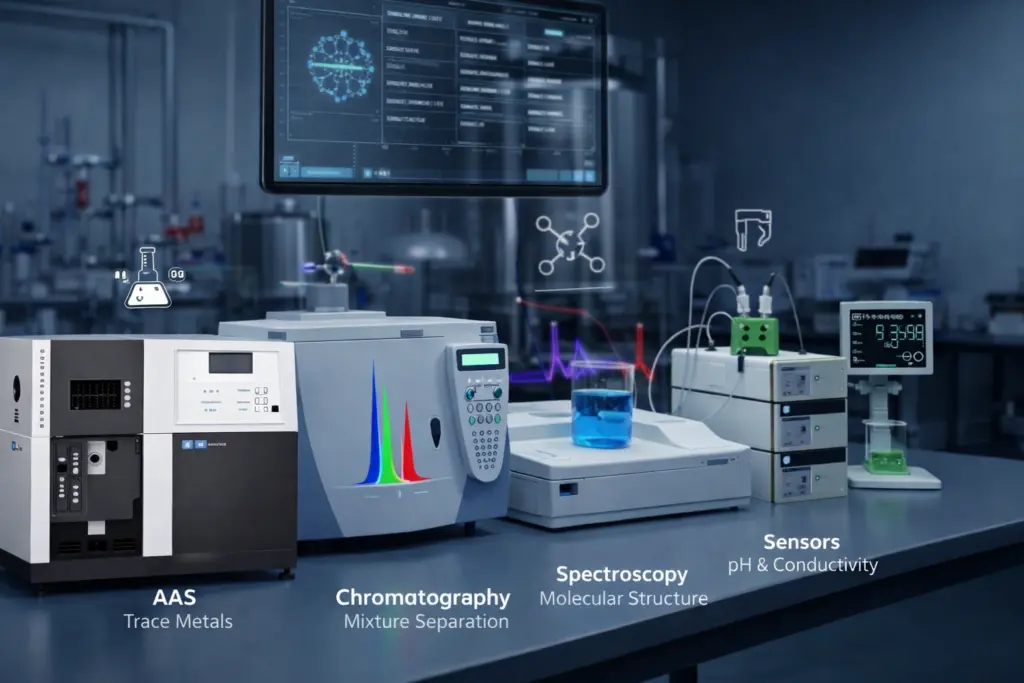
In the complex world of chemical manufacturing, knowing what’s in your product is non-negotiable. But just as a carpenter needs different tools for different jobs, chemical engineers rely on a suite of analytical instruments, each designed for a specific task. Today, we’re diving into where Atomic Absorption Spectroscopy (AAS) fits among its peers.
Why So Many Instruments?
Imagine trying to find a needle in a haystack (AAS’s job) versus separating all the different types of hay (Chromatography’s job). Different problems require different solutions. While many instruments provide critical data, their focus areas vary significantly.
AAS: The Metal Detector Specialist
Atomic Absorption Spectroscopy (AAS) is the ultimate instrument when you need to detect and quantify specific metals (like lead, copper, iron, zinc, or mercury) at very low levels in a sample.
Key Strengths of AAS:
- Trace Metal Analysis: Unparalleled sensitivity for finding even tiny concentrations of metals.
- Purity Control: Crucial for pharmaceuticals, food, and high-purity chemicals where metal contamination is a major concern.
- Environmental Monitoring: Essential for testing wastewater and emissions for heavy metals.
Think of AAS as your dedicated metallurgist, specifically trained to sniff out metallic elements.
How AAS Stacks Up Against Other Key Instruments
Here’s a comparison to highlight the unique role of AAS:
| Instrument | Primary Function | What it Measures Best | Example Use in Manufacturing |
| AAS | Trace Metal Detection | Specific metallic elements (e.g., Pb, Fe, Cu) | Checking drug batches for heavy metal impurities; monitoring metal content in industrial wastewater. |
| Chromatography (GC, HPLC) | Separation & Identification of Complex Mixtures | Organic compounds, solvents, different components in a blend | Ensuring the correct ratio of ingredients in a perfume; checking for unwanted byproducts in a chemical reaction. |
| Spectroscopy (UV-Vis, IR) | Concentration & Molecular Structure | How much light a substance absorbs; identifying functional groups | Monitoring the concentration of a colored dye; confirming a specific chemical bond formed in a polymer. |
| Electrochemical Sensors (pH, Conductivity) | Basic Chemical Properties | Acidity/basicity, ionic content in solutions | Maintaining optimal pH for a fermentation process; checking water purity. |
So, Which Tool Wins?
Honestly, there’s no single “best” instrument in the lab—it’s all about picking the right tool for the specific headache you’re trying to solve. While Chromatography is your go-to for untangling complex organic mixtures and Spectroscopy is great for getting a look at molecular structures, Atomic Absorption Spectroscopy (AAS) is the undisputed heavyweight when you need to hunt down trace metals. By knowing exactly what each piece of gear brings to the table, you can keep your manufacturing process running smoothly, stay compliant, and—most importantly—keep your product quality rock-solid.
Need a hand keeping your lab up and running? Whether it’s calibration, maintenance, or repair, we service all these instruments, ensuring your chromatography, spectroscopy, and AAS systems are always performing at their peak. Getting your head around these tools is the first step to cleaner data, but having a reliable partner to look after them is what gives you peace of mind. If you’re looking to streamline your workflow or need support with your current quality control routine, let’s chat—I’m happy to help you map out a maintenance strategy.