

Viscometer Calibration
Lab
Accredited Lab
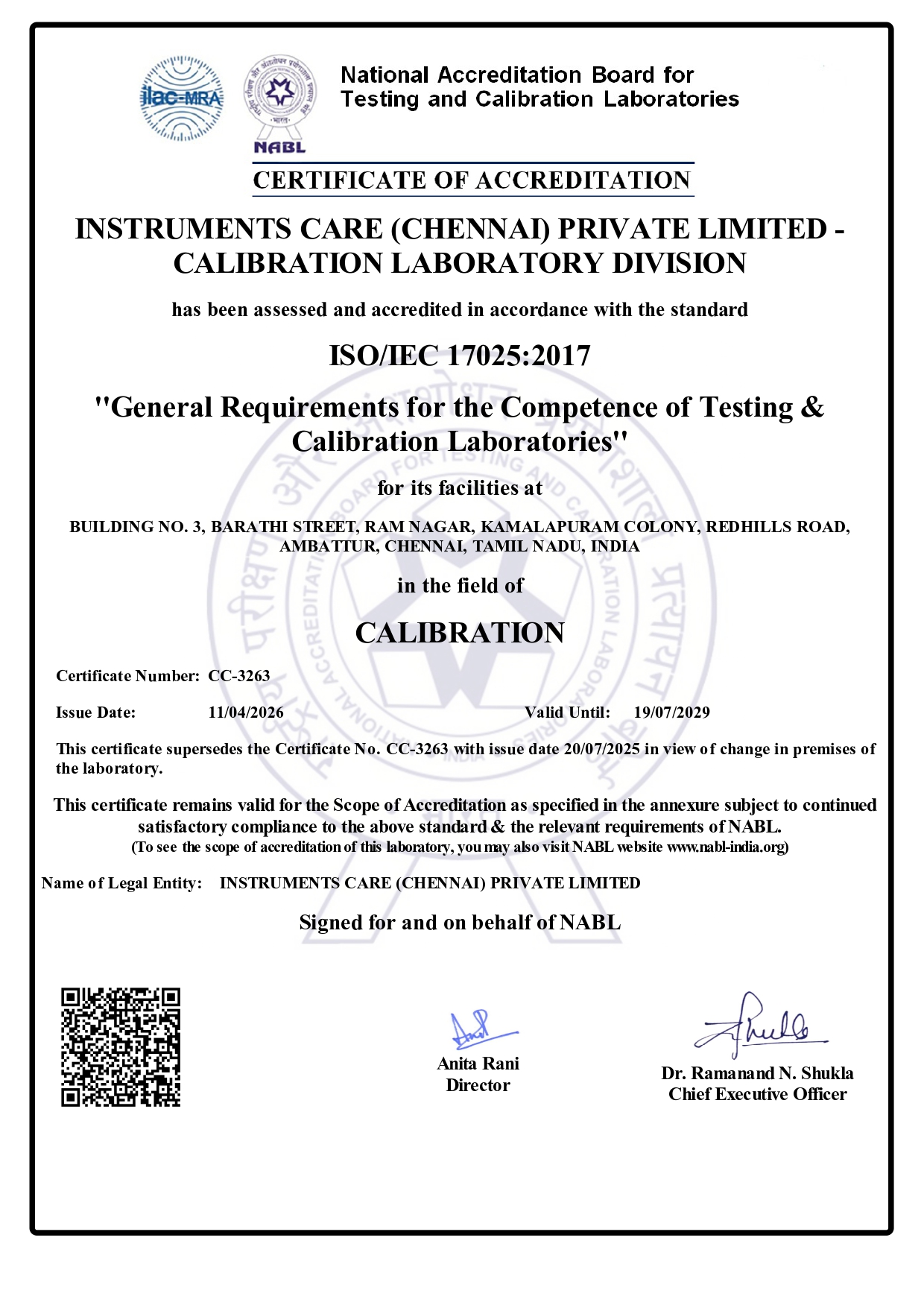
Calibration executed at our NABL Accredited Lab as per ISO/IEC17025:2017
standards and a relevant calibration certificate will be issued.
Calibration with UKAS Standards
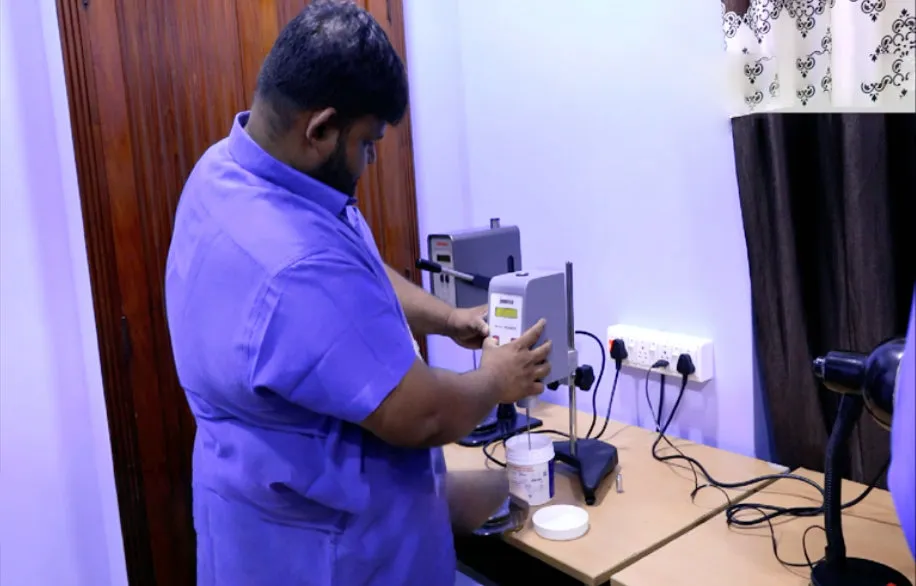
Executed both in the Customer place and our Service lab. Checking the instrument with UKAS Standards (Low, Medium & High Range). If any deviations are observed, they will be adjusted both in Micro Mechanical and Electronics sections to obtain optimum results and relevant calibration certificates will be provided.
Supply of Accessories
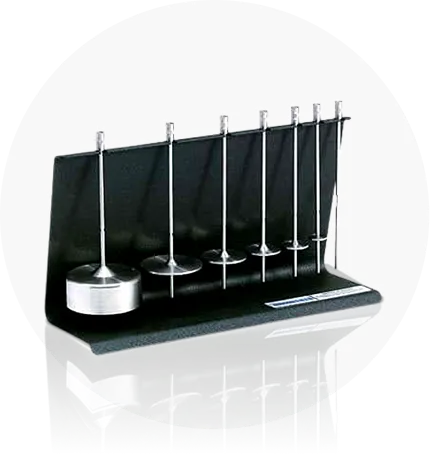
Lab Stand
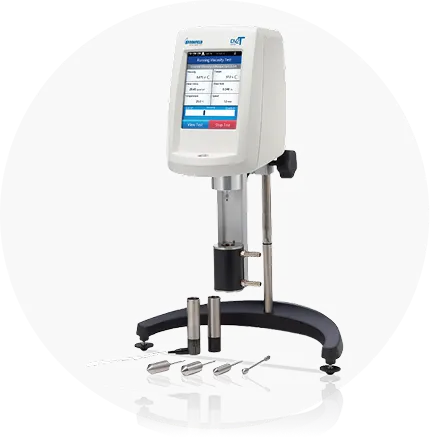
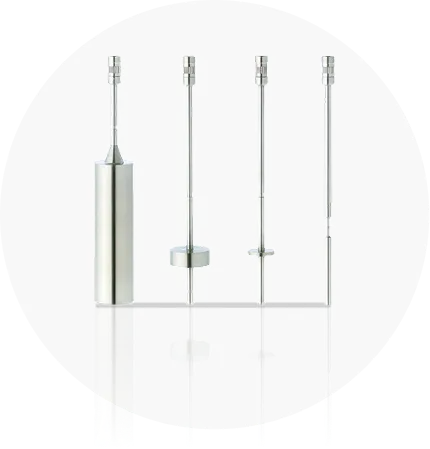
RV Spindle Set
LV Spindle Set
What Is a Viscometer, and Why Is It Important?
A viscometer is a high-precision analytical instrument used to measure the viscosity of a fluid—essentially, it measures a liquid’s internal resistance to flow. While a thermometer measures heat, a viscometer measures “thickness” or “friction” within a substance.
How It Works?
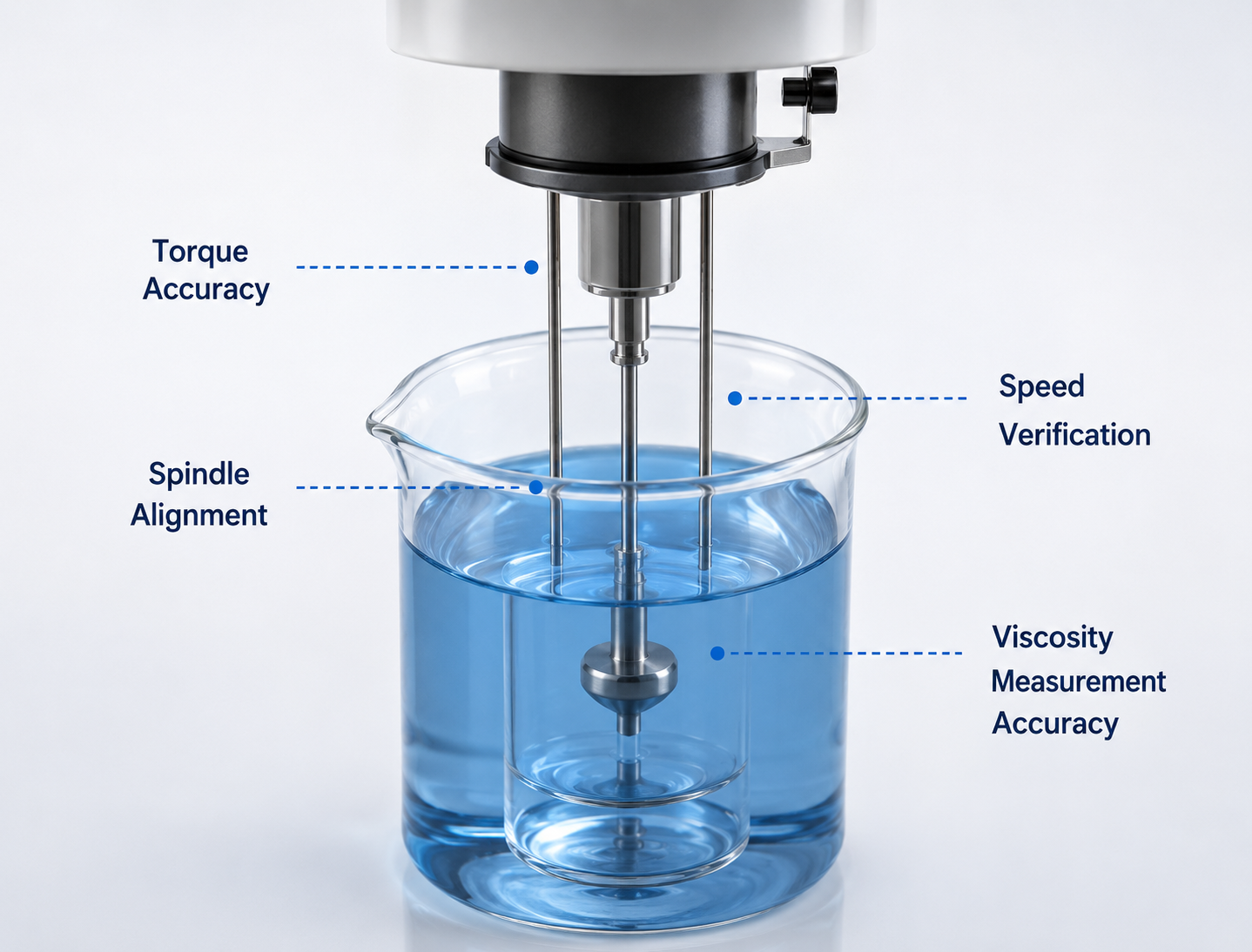
Most modern laboratory viscometers, such as the Brookfield models serviced by Instruments Care, operate on the principle of Rotational Viscometry. A spindle is submerged in the test fluid and rotated at a defined speed. The instrument measures the torque required to overcome the viscous resistance to that movement.
Understanding the principles of rotational viscometry
1. Spindle Submerged
A precision spindle is submerged in the test fluid sample
2. Rotation at Defined Speed
The spindle rotates at a precisely controlled speed
3. Torque Measured
The instrument measures torque required to overcome viscous resistance
Rotational Viscometry:
Most modern laboratory viscometers, such as the Brookfield models serviced by Instruments Care, operate on this principle. The measured torque directly correlates to the fluid’s viscosity, providing precise, repeatable measurements essential for quality control
Why Is Viscosity Important?
In industrial manufacturing, viscosity is often the most critical indicator of product quality and process efficiency
Product Consistency
For brands to maintain a consistent “mouthfeel” in sauces or “spreadability” in skin creams, the viscosity must be identical across every batch
Processability
If a fluid is too thick, it can damage industrial pumps and piping; if it is too thin, it may leak or fail to coat surfaces properly.
Predicting Performance
Viscosity determines how well a paint will stick to a wall without sagging, or how effectively a lubricant will protect an engine at high temperatures.
Quality Indicator
Changes in viscosity can signal a chemical reaction has finished, a formulation has been contaminated, or a product has reached its shelf-life limit.
The Need for Accuracy
Because a viscometer relies on delicate internal components like hairsprings and pivot points, it is prone to mechanical drift.
This is why professional calibration and service are vital; even a 1% error in measurement can lead to a failed production batch worth lakhs of rupees.
Viscometers are devices used to measure the viscosity of a liquid—its resistance to flow under specific conditions.
Viscosity plays a central role in how materials are formulated, processed, and evaluated.
It directly impacts product stability, application performance, and compliance with industry standards.
Used across R&D and production environments, viscometers monitor and control flow properties.
They range from simple manual instruments to advanced digital systems capable of automated, high-precision measurements.
Engineers, formulators, and quality control specialists rely on viscometers to validate product specifications, adjust formulations,
and ensure batch-to-batch consistency.
Industry Applications
Viscosity measurement spans multiple industries, each with unique requirements and standards
Pharmaceuticals
Viscosity affects drug stability, syringeability, and dosing accuracy
Food & Beverage
Influences mouthfeel, pourability, and texture consistency
Chemicals
Governs application and performance of coatings, adhesives, and lubricants
Advanced Materials
Supports development of products with specialized flow and structural characteristics
ISO/IEC 17025 Certified
ISO/IEC17025:2017
Standards
Calibration Executed at our Lab
as per ISO /IEC17025:2017
Standards for all Rotational
Certificate will be issued.
Torque & Linearity Validation
Our engineers perform multi-point calibration to verify torque sensing accuracy from 10% to 100% of the full-scale range.
Comprehensive Documentation
Every calibration is followed by a detailed Certificate of Calibration containing As-found and As-left data. Uncertainty measurements. Traceability charts for audit compliance (FDA, ISO, GLP/GMP).
why viscometer calibration is important ?
Viscometer calibration is the cornerstone of quality assurance, ensuring that your instrument's torque-sensing hairspring and mechanical pivots maintain the precision required to deliver consistent, repeatable data. Without regular calibration to
NABL-traceable standards, even high-end instruments like Brookfield models can suffer from "measurement drift" due to mechanical wear or environmental changes.
This leads to the risk of either rejecting perfect batches or releasing sub-standard products. By validating your equipment against ASTM D2196 or ISO 2555 protocols, you guarantee compliance with
FDA, GLP, and ISO audits while protecting production efficiency.
why viscometer calibration is important ?
Viscometer calibration is the cornerstone of quality assurance, ensuring that your instrument's torque-sensing hairspring and mechanical pivots maintain the precision required to deliver consistent, repeatable data. Without regular calibration to NABL-traceable standards, even high-end instruments like Brookfield models can suffer from "measurement drift" due to mechanical wear or environmental changes.
This leads to the risk of either rejecting perfect batches or releasing sub-standard products. By validating your equipment against ASTM D2196 or ISO 2555 protocols, you guarantee compliance with FDA, GLP, and ISO audits while protecting production efficiency.
Instruments Care Has Viscometer Calibration Expertise
For over 28 years, Instruments Care (Chennai) Pvt Ltd has built a reputation as the premier authority in Viscometer Calibration. Our trained engineers utilize NIST-traceable certified viscosity standards to validate torque linearity, spring sensitivity, and spindle geometry.
We understand that in rheology; even a minor deviation can compromise an entire production batch.
As an ISO/IEC 17025 Certified Viscometer Calibration provider, we deliver world-class calibration services for all models of Rotational Viscometers, specializing in Brookfield and other leading global brands.
When you send your viscometer to us for calibration, we ensure your instrument is operating accurately by:
- ✓ Inspecting the instrument to identify degradation that could affect measurement accuracy.
- ✓ Checking the functionality of the viscometer’s internal mechanisms.
- ✓ Evaluating the pivot point and shaft for precision and stability.
Brookfield viscometer service or viscometer calibration in Bangalore?
Looking for reliable Brookfield Viscometer Service or viscometer calibration in Bangalore?
Instruments Care provides NABL-traceable, ISO-compliant calibration services to industries throughout the Bangalore metropolitan area. We provide comprehensive services across Bangalore city, maintaining a strong commitment to excellent customer service in numerous areas, including Peenya, Jayanagar, Doddabellapur, Yelakanka,Bommasamdra, Hosur, Bangalore Main City, Shaivanagara and Electronic City.We specialize in repairing and servicing a wide range of viscometers including, Brookfield Viscometer, Rotational Viscometers, Cone Plate Viscometers, Digital And Analog Viscometers.