


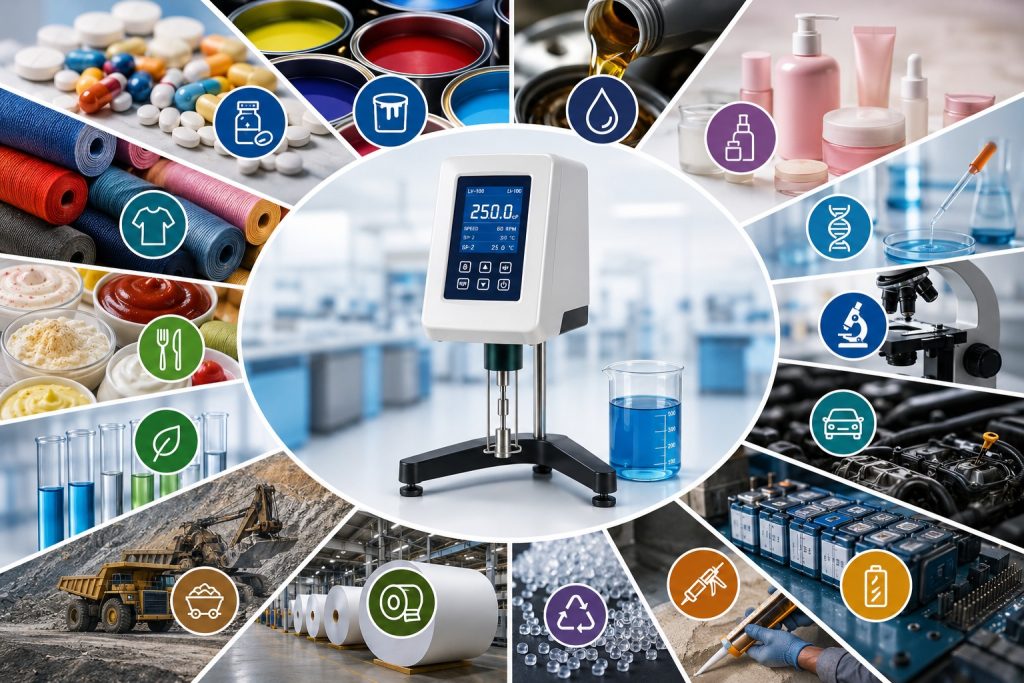
Viscosity is one of the most critical fluid properties measured across industries — from life saving injectables to motor oils, from chocolate to paint. Wherever viscosity matters, viscometer calibration is essential. This blog explores the top industries that require viscometer calibration, why each industry needs it, and what to look for in a calibration partner.
1. Pharmaceutical Industry
The pharmaceutical industry is the most demanding user of viscometer calibration.
Why it matters:
- Affects dose uniformity in syrups, suspensions, and injectables
- Impacts spreadability of creams, gels, and ointments
- Influences syringeability and patient comfort
- Affects coating thickness in tablet film coating
- Impacts stability and shelf life of formulations
Regulations:
- WHO-GMP, US FDA 21 CFR Part 211, EU GMP
- USP <912>, USP <1058>
- Schedule M (India)
Typical calibration frequency: Every 6 months, with daily verification.
2. Food & Beverage Industry
Viscosity affects taste, mouthfeel, pourability, and processing efficiency in countless food products.
Common applications:
- Sauces, ketchup, mayonnaise
- Honey, syrups, jams
- Yogurt, dairy creams, ice cream mixes
- Beverages, fruit juices, concentrates
- Chocolate and confectionery
- Edible oils
Why it matters:
- Ensures consistent product quality and consumer experience
- Supports HACCP and FSSAI compliance
- Optimises filling, mixing, and packaging line efficiency
Typical calibration frequency: Every 6 to 12 months.
3. Paint, Coatings & Inks Industry
Viscosity is the single most important parameter in paints, varnishes, lacquers, and printing inks.
Why it matters:
- Determines flow, levelling, and finish
- Affects sprayability and brushability
- Impacts drying time and film thickness
- Critical for consistent colour and gloss
- Drives line speed and waste reduction
Common standards:
- ASTM D2196 (rotational viscosity for paints)
- BS 3900, ISO 2884
- Krebs-Stormer viscosity (KU)
Typical calibration frequency: Every 12 months.
The cosmetic industry uses viscometers daily for creams, lotions, shampoos, conditioners, gels, and serums.
Why it matters:
- Determines product texture and feel
- Affects packaging compatibility (pump dispensers, tubes)
- Critical for shelf-life and stability
- Ensures batch-to-batch consistency for brand experience
- Supports compliance with COSMOS, ISO 22716, and FDA cosmetic GMP
Typical calibration frequency: Every 6 to 12 months.
4. Petrochemical & Lubricants Industry
Viscosity is a defining property of fuels, lubricants, greases, and crude oil products.
Why it matters:
- Determines lubrication performance under load and temperature
- Affects fuel atomisation and combustion
- Critical for engine and machinery protection
- Drives compliance with API, SAE, and ISO grades
- Influences pumping and pipeline transportation
Common standards:
- ASTM D445, ASTM D2270
- IS 1448
- API service categories
- SAE J300 (engine oils)
Typical calibration frequency: Every 6 months due to safety-critical nature.
5. Adhesives & Sealants Industry
Adhesives must have specific viscosity for proper application — too thick won’t spread, too thin won’t bond.
Why it matters:
- Affects application method (spray, brush, roll, dispense)
- Impacts bond strength and curing time
- Critical for automated dispensing equipment
- Determines shelf life and pot life
Typical calibration frequency: Every 6 to 12 months.
6. Polymer & Plastics Industry
Polymer melt viscosity, solution viscosity, and resin viscosity are routinely measured during R&D and quality control.
Why it matters :
- Determines moulding and extrusion behaviour
- Affects fibre spinning and film formation
- Critical for polymer molecular weight characterisation
- Drives processing parameters
Typical calibration frequency: Every 12 months for QC viscometers.
7. Chemical & Specialty Chemicals Industry
From surfactants to silicones, from solvents to specialty chemicals, viscosity is a key process and quality parameter
Why it matters:
- Drives reactor design and process control
- Affects pumping, mixing, and heat transfer
- Critical for product specification and customer acceptance
- Supports REACH, GHS, and IS compliance
Typical calibration frequency: Every 6 to 12 months.
8. Biotechnology Industry
Biotech products — including monoclonal antibodies, vaccines, and cell culture media — have specific viscosity requirements.
Why it matters:
- Affects filtration, ultrafiltration, and chromatography
- Critical for fill-finish operations
- Influences syringeability of biologics
- Supports USP, EP, and FDA biologics compliance
Typical calibration frequency: Every 6 months.
9. Pulp & Paper Industry
Viscosity of coatings, sizing agents, and pulp slurries is monitored to control paper quality.
Why it matters:
- Affects coating uniformity and printability
- Critical for ink absorption and gloss
- Drives runnability on high-speed paper machines
Typical calibration frequency: Every 12 months.
10. Construction Chemicals Industry
Tile adhesives, waterproofing compounds, admixtures, and sealants all require viscosity control.
Why it matters:
- Affects workability and application time
- Critical for shelf life and stability
- Drives compliance with IS, ASTM, and EN standards
Typical calibration frequency: Every 12 months.
11. Research & Educational Institutions
Universities, R&D labs, and CROs use viscometers daily for product development, formulation studies, and analytical work
Why it matters:
- Ensures research data is accurate and publishable
- Supports NABL / ISO 17025 accreditation for testing labs
- Critical for client-facing testing reports
Typical calibration frequency: Every 12 months.
Common Viscometer Brands Calibrated Across These Industries
NABL-accredited calibration laboratories typically service:
- Brookfield (DV-I, DV-II, DV-III, DV2T, DV3T, RVDV, LVDV)
- Anton Paar (ViscoQC, MCR rheometers)
- Fungilab
- Lamy Rheology
- IKA
- Rheometric / TA Instruments
- Haake / Thermo Scientific
- Cannon-Fenske and Ubbelohde glass viscometers
Final Thoughts
Whether you manufacture life-saving injectables, premium chocolate, automotive lubricant, or industrial paint — your viscometer is one of the most important quality instruments in your facility. Across every one of these industries, NABL-accredited viscometer calibration is the foundation of accurate measurement, regulatory compliance, and product excellence.
Looking for a trusted NABL-accredited viscometer calibration partner across India? We serve pharmaceutical, food, paint, cosmetic, petrochemical, and chemical industries with on-site and lab-based calibration services for all major viscometer brands. Contact us today for a free quote.